


A Growth Matters International Point of View
Sales teams do not have a productivity problem. They have an addition problem.
When growth slows, pipeline thins or targets are missed, the instinctive response is usually to add something. More activity. More tools. More training. More dashboards. More methodology. More AI. More enablement.
Each addition could make sense in isolation. Together, the additions can create exactly the opposite of what was intended: more complexity, more cognitive load, more noise. And therefore, there is less capacity for the work that actually creates customer value.
The salesperson experiences the accumulated system.
Sales growth will not be won by the organisations that do the most. It will be won by those that make the fewest things matter most.
The Addition Trap
Sales organisations rarely become complex by design. Complexity accumulates over time.
A new methodology is introduced without retiring the old language. A new dashboard is launched, but the spreadsheet remains. A new tool promises productivity, but creates another workflow. A capability program adds behaviours without removing anything else. A manager receives another reporting responsibility without anything being taken away.
Every decision makes sense in isolation. The problem is that the salesperson experiences the accumulated system.
What began as support becomes navigation. What began as enablement becomes another demand. What began as insight becomes noise.
Nobody owns subtraction.
This matters because selling is a series of judgement calls. Which opportunity deserves attention? What does the customer really need? What priority problem are we solving? Who is missing from the decision? Where is the real risk? What should happen next?
Every unnecessary layer around the salesperson competes with the cognitive capacity required to answer those questions well.
The Real Productivity Question
For years, sales leaders have asked: “How do we get salespeople to do more?”
Today, that is the wrong question.
The better question is: “How do we make it easier for salespeople to do what matters most, consistently and at scale?”
That shift requires two leadership practices.
We call them Sales Simplifiers and Sales Multipliers. Great sales organisations need both.
Two Leadership Practices
Sales Simplifiers remove friction
A Sales Simplifier reduces the effort required to identify and execute the behaviours that matter most.
The objective is not to make selling simplistic. The objective is to remove the avoidable complexity created around the salesperson.
Simplifiers ask what can be removed, integrated, automated, clarified or made easier. They challenge whether a report is still needed, whether a meeting improves decisions, whether a tool reduces work, and whether a capability framework has become too broad to guide behaviour.
Simplification is not convenience. It is performance design.
Sales Multipliers increase impact
As Simplifiers remove friction, Sales Multipliers increase the return on the effort that remains.
They ask how good judgement becomes repeatable, how individual expertise can be built into organisational capability, how one manager improves ten salespeople rather than personally rescuing ten deals, and how technology creates capacity for higher-value human work.
Multiplication is not asking one salesperson to do the work of two. It is making each unit of effort more valuable.
Most importantly, Multipliers understand that multiplication happens through people.
Simplify the system. Multiply the human.
The Manager Is the Multiplier
Many organisations invest heavily in salespeople. Fewer invest with the same discipline in the people responsible for creating sales performance through salespeople.
That is the paradox.
The manager influences pipeline quality, forecast accuracy, coaching impact, execution success and the cultivation of culture. The manager is not another layer in the system. The manager is the operating system.
Across Growth Matters International customer engagements, one pattern appears consistently: when managers improve, performance compounds. When managers struggle, complexity compounds.
The manager is the difference between complexity and capability, between activity and impact, and between growth and stagnation.
No role multiplies performance more consistently than the front-line Sales Manager.
What We Have Seen
This is not theory. It is visible in our customer work.
Global manufacturing: capability developed at scale
In one global manufacturing organisation, Growth Matters International partnered on a nine-year journey that expanded from a regional pilot to a global deployment involving more than 600 sales managers.
The objective was not simply better training. It was to build managers capable of driving performance through others.
The impact study shows improvements of more than 21% in manager effectiveness, more than 25% in pipeline health and forecast accuracy, and more than 30% in sales culture.
Global enterprise software: coaching that changes deal outcomes
In a global enterprise software organisation, 235 sales managers participated in a structured deal coaching program across three regions: EMEA, JAPAC and the Americas.
The challenge was not a lack of tools, systems or enablement. The challenge was converting those investments into better decisions and better execution.
The impact study records an immediate 11% improvement in win rate, a 15% improvement in opportunity progression, and a 25% reduction in lost or stalled opportunities.
Different industries. Different geographies. Different business challenges. The same lesson.
The Manager is the Multiplier.
The GMI Simplifier-Multiplier Matrix
Simplification and multiplication are not competing ideas. They are independent dimensions of an effective sales performance system. The combination determines the environment in which salespeople and managers operate.
Moving up the matrix removes friction. Moving to the right increases return.
The Addition Trap (low simplification, low multiplication)
Busy is mistaken for better. More noise; less progress.
Scaled Friction (low simplification, high multiplication)
A machine spreading complexity faster. Capability and technology amplify a fragmented system.
The Clean Plateau (high simplification, low multiplication)
Lean, calm and capped. Friction is gone, but nothing compounds.
The Flywheel (high simplification, high multiplication)
Less friction, more leverage. Every unit of effort is worth more than the last.
The destination is the top-right quadrant: The Flywheel. Energy goes in once and effort compounds. Simplification creates the space for better judgement, and multiplication turns that space into stronger execution.
Four Areas Where the Combination Matters Most
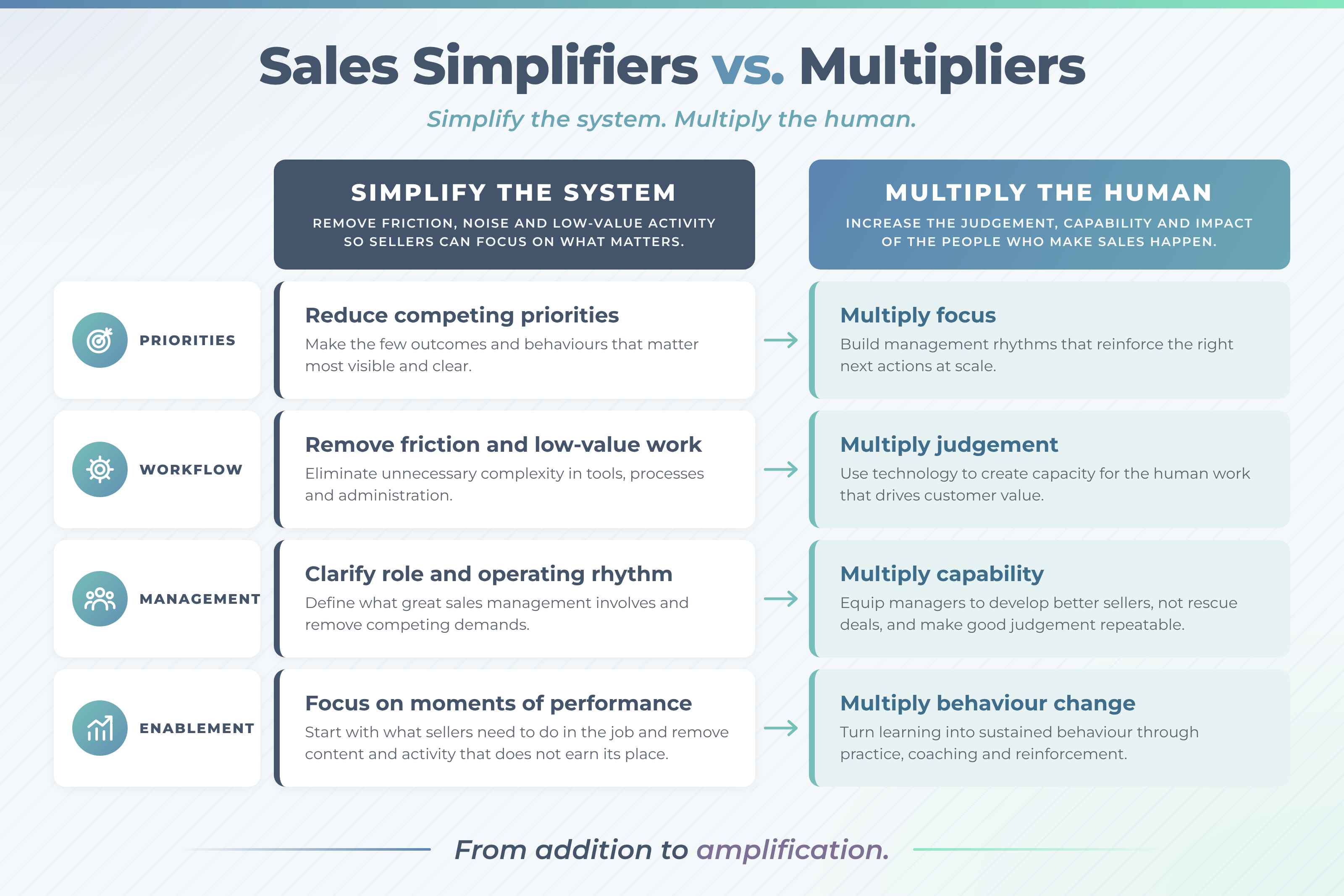
1. Priorities: from noise to focus
Simplifiers make the prioritised outcomes and behaviours that matter most visible. Multipliers build management rhythms around them, so pipeline and deal reviews, forecasting, and coaching reinforce the same choices.
2. Workflow: from complexity to judgement
Technology should remove work around the salesperson, not create another layer of work for the salesperson. Use automation for repetitive research and administration. Protect human capacity for interpretation, challenge, innovation and customer understanding.
3. Management: from control to capability
Simplification starts with role clarity. Multiplication begins when the manager moves from giving answers to improving the quality of thinking around them. The strongest manager builds better salespeople rather than becoming indispensable for every deal.
4. Enablement: from content to behaviour change
Simplifiers start with the moment of performance. Multipliers make the required behaviour repeatable through practice, feedback, coaching and reinforcement. The unit of enablement is not content delivered. It is behaviour changed.
The Simplifier-Multiplier Test
Before introducing another initiative, tool, meeting, technology or program, leaders should ask two questions.
1. What does this simplify?
What friction disappears? What becomes clearer? What low-value work is removed? What decision becomes easier?
2. What does this multiply?
Will this give us better judgement? Will our coaching improve? Will it build greater capability, create more customer value or instil repeatable behaviours?
If anything new does neither, its place in the sales system deserves to be challenged.
The Leadership Questions Need to Change
- What have we added that should no longer exist?
- Where are salespeople spending effort without creating customer value?
- Which decisions have we made unnecessarily difficult?
- Which few behaviours would make the greatest difference to performance right now?
- What should technology remove rather than add?
- Are our managers multiplying capability, or compensating for its absence?
- When we create capacity, do we know where we want to reinvest it?
These are not cost-cutting questions. They are growth questions.
From Addition to Amplification
There will always be pressure to add. A missed quarter makes another dashboard attractive. A capability gap makes another training program feel necessary. A new technology creates fear that competitors are moving faster.
But sales organisations cannot continue trying to add their way to productivity. Every new initiative competes for the same finite resource: human energy and attention.
The organisations that outperform will simplify systems, remove friction and reduce complexity. They will use technology to create capacity rather than complexity. They will judge enablement by what changes in the work, not by how much is delivered.
Most importantly, they will invest in the role that converts organisational intent into daily performance: the Sales Manager.
Growth is not the result of maximum activity. It is the result of clearer systems and stronger humans.
The strongest multiplier in the system is the manager.
Simplify the system. Multiply the manager. Elevate the human.
That is how organisations move from addition to amplification.


